

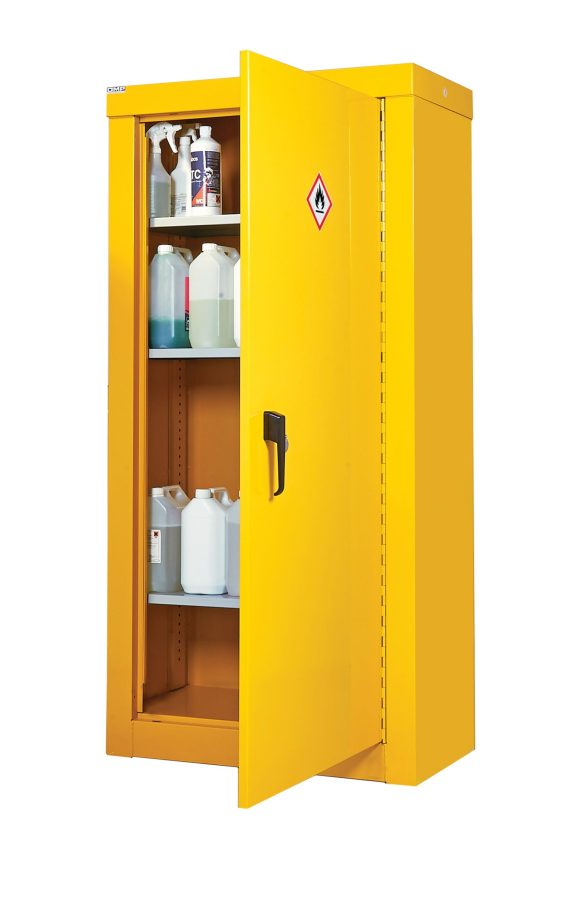
The sole objective of CoSHH containers is to ensure the secure storage of hazardous substances and to mitigate the associated risks. In contrast to generic storage cabinets, CoSHH cabinets are constructed with safety, containment, and compliance in mind, rendering them a significantly more specialised option for workplaces that store chemicals, cleaning agents, solvents, or other potentially hazardous materials.
Initially, CoSHH cabinets may appear to be similar to conventional storage cabinets; however, this superficial resemblance can be deceptive. A generic cabinet is typically designed to house items in an organised manner, while CoSHH cabinets are intended to assist in the regulation of exposure, the prevention of spillage, and the restriction of unauthorised access. This distinction is significant because hazardous substances can pose significant hazards if they are stored in an inappropriate unit.
The construction of CoSHH cabinets is one of the primary distinguishing features. The reinforced structure required for hazardous materials may not be present in generic storage cabinets, as they are frequently intended for general-purpose use. In contrast, CoSHH containers are typically constructed with more durable materials, secure locking mechanisms, and features that facilitate safe storage in environments where spillage, fumes, or inadvertent contact could result in injury.
Another significant distinction is containment. CoSHH containers are typically constructed to prevent minor accidents from escalating into more severe hazards by containing spills or drips. Although a standard storage cabinet may have doors and shelving, it typically lacks the same spill-management features. A base or sump area is frequently included in CoSHH containers to capture leaked liquid, which is particularly crucial when storing chemicals that have the potential to damage the adjacent workstation, equipment, or surfaces.
Shelving design also demonstrates the distinction between CoSHH cabinets and generic storage cabinets. Shelves are primarily designed for the purpose of maximising space efficiency and convenience in a standard cabinet. In order to prevent items from sliding during use and to ensure that containers remain vertical, CoSHH cabinets frequently incorporate raised edges or other features into their shelving. In hectic work environments where cabinets are frequently opened and closed, that minor detail can have a substantial impact.
Security is equally critical. A simple closure or handle may be used to close generic cabinets, but CoSHH cabinets are typically lockable to ensure that only authorised personnel can access the contents. This is essential in environments where hazardous products must be kept out of the reach of children, visitors, or employees who have not received proper training to use them safely. CoSHH cabinets are not merely storage lockers; they are also about responsible handling and controlled access.
Labelling and visibility are additional factors that distinguish CoSHH cabinets from average cabinets. Warning notices are seldom necessary for a generic storage cabinet; however, CoSHH cabinets are frequently labelled to indicate that they contain hazardous substances. This enables staff to promptly identify the contents and serves as a reminder to all those in the vicinity that additional care is required. It is simpler to adhere to workplace procedures and promotes safer protocols when clear identification is implemented.
Another significant distinction is the manner in which CoSHH cabinets facilitate compliance. Standard storage containers may be perfectly acceptable for documents, tools, stock, or general supplies; however, they are not intended to comply with hazardous-substance regulations. The purpose of CoSHH containers is to assist workplaces in fulfilling their obligations regarding the storage of hazardous materials. Thus, they are not merely an additional piece of furniture; rather, they are a practical component of a broader safety system.
Additionally, ventilation may be relevant, contingent upon the contents of the storage facility. Because they are not designed for this purpose, generic cabinets typically do not take into account the behaviour of chemicals, vapours, or emissions. CoSHH cabinets may be chosen with features that are tailored to the specific substance being stored, ensuring that the cabinet is secure for use rather than merely holding receptacles in position. The precise design is contingent upon the nature of the hazard, which is why CoSHH cabinets are more specialised than standard cupboards.
Another distinction is the manner in which CoSHH cabinets are integrated into the workplace organization. A generic cabinet is frequently selected for its convenience and available space, while CoSHH cabinets are typically selected after an assessment of the substances, quantities, and risks. This implies that the cabinet should be in accordance with the materials’ characteristics, rather than solely the room’s dimensions. In practice, CoSHH containers assist workplaces in the separation of hazardous items from commonplace stock, thereby minimising the likelihood of accidental mixing or misuse.
Durability is also crucial. Generic storage cabinets may experience wear and tear over time when utilised in demanding environments; however, CoSHH cabinets are designed to endure more severe conditions. They are frequently employed in environments such as workshops, laboratories, and maintenance areas, where they are subjected to frequent use and chemical exposure. As a result, CoSHH containers are typically constructed to be more durable than a standard storage unit.
Additionally, there is a discrepancy in the manner in which employees are anticipated to utilise the cabinet. Typically, a storage cabinet that is generic is simple to operate: simply open it, retrieve the necessary items, and then reclose it. Because they are a component of a controlled safety procedure, CoSHH cabinets necessitate additional discipline. The cabinet should be kept sealed when not in use, incompatible substances should not be combined, lids should remain secure, and items should be stored properly. The additional level of attention is a distinguishing characteristic of CoSHH cabinets.
In numerous workplaces, CoSHH cabinets are selected not due to their aesthetic appeal, but rather because they address a particular issue. They contribute to the prevention of preventable catastrophes, the promotion of safer substance management, and the establishment of a more responsible storage system. Generic storage containers have their place; however, they are not intended to mitigate chemical risks in the same manner. That is why CoSHH cabinets are deemed indispensable in any location where hazardous substances are present.
Purpose, protection, and practicality are the distinguishing factors between CoSHH cabinets and generic storage cabinets. A generic cabinet is used to store goods, while CoSHH cabinets are designed to ensure the secure storage of hazardous substances. They are significantly more specialised than conventional storage options due to their reinforced construction, leak containment, securing features, warning labels, and suitability for controlled environments. The selection of CoSHH containers is a matter of safety rather than convenience for any workplace that handles hazardous materials.