

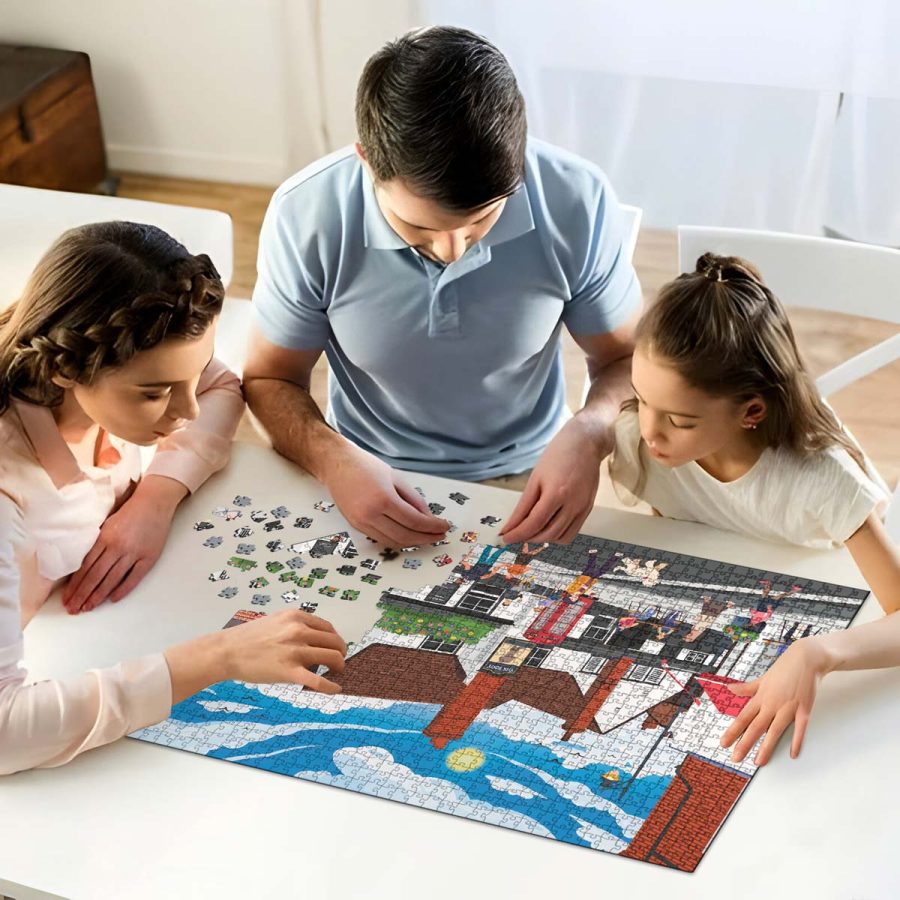
There is a particular silence that falls over a living room when a jigsaw is spread across the table. It is not the silence of boredom but of concentration, a gentle, companionable hush broken only by the occasional triumphant click of a piece finding its home. For many people across the UK, this has become one of the most rewarding ways to spend a wet Sunday afternoon, a long winter evening or a week of holiday downtime. Among the countless options available, 1000-piece jigsaw puzzles of British places and landmarks stand out as the ultimate challenge, and there are good reasons why.
The Sweet Spot of Difficulty
Anyone who has completed a few puzzles will tell you that size matters. A 250-piece puzzle can be finished in an evening and rarely demands much beyond patience. A 2000-piece puzzle can swallow an entire dining table for weeks and test the goodwill of everyone in the household. The 1000-piece jigsaw puzzle sits in the perfect middle ground: large enough to be properly demanding, yet small enough to be completed over a few sittings.
This balance is what makes 1000-piece jigsaw puzzles so compelling. They are substantial enough that the middle stage, when the border is done and the easy sections are finished, becomes a genuine test of observation and resolve. Yet they never feel impossible. There is always a sense that the finish line is within reach if you can only stay the course for another hour or two. That tension between difficulty and attainability is the heart of a great challenge, and few other leisure activities capture it so neatly.
Why British Scenes Are So Fiendishly Good
Choose a picture of a British town or city and you will quickly discover that the subject matter itself is part of the challenge. Our places are layered, textured and wonderfully busy. Think of a harbour town in Cornwall, with its tumble of whitewashed cottages, fishing boats, ropes, lobster pots and gulls. Think of a view across the rooftops of Edinburgh, where chimney pots, spires, slate tiles and weathered stone merge into one glorious jumble. Think of a London skyline at dusk, with hundreds of lit windows that look almost identical until you study them closely.
These scenes reward the sort of attention that makes 1000-piece jigsaw puzzles so satisfying. Brick walls, thatched roofs, cobbled lanes and ornate Victorian ironwork all create repeating patterns that look deceptively similar. You may hold a piece for several minutes, convinced it belongs to a particular chimney stack, only to discover it is the corner of a window two inches to the left. It is maddening and wonderful in equal measure.
Then there is the British sky. Anyone who has attempted a landmark puzzle with a large expanse of grey cloud knows the particular despair of sorting through dozens of nearly identical pieces. A seaside promenade under a moody, overcast sky is among the most testing images imaginable, and completing it carries a quiet pride that an easier subject never could.
Familiarity That Makes It Personal
One of the great pleasures of choosing a puzzle depicting a UK place is the connection it creates. A jigsaw showing the cliffs of Dover, the spires of Oxford or the terraces of Bath is not just an abstract image; it is somewhere you may have visited, lived or dreamed of seeing. As the picture slowly emerges, memories emerge with it. You might recall a damp weekend in the Lake District, a childhood trip to the seaside or the first time you walked across a famous bridge.
This emotional pull makes 1000-piece jigsaw puzzles of British landmarks far more engaging than generic scenes. You are not simply matching shapes and colours; you are rebuilding a place that means something. That sense of purpose can carry you through the trickiest stretches, when progress feels slow and the temptation to give up is strong. You want to see that familiar skyline or harbour complete, and the desire to do so is a powerful motivator.
For those who have never visited the place on the box, a puzzle can serve as a gentle introduction. Working through a view of a Welsh castle or a Yorkshire market town gives you an intimate familiarity with its details, from the carvings above a doorway to the arrangement of boats along a quay. Many people find that finishing a puzzle inspires them to plan a visit and compare the real thing with the version they have so carefully assembled.
The Quiet Psychology of Piece-Finding
There is something deeply satisfying about the process of solving a jigsaw, and it is worth considering why. Each successful match delivers a small burst of pleasure, a tiny reward for your effort. Across a puzzle with a thousand pieces, those rewards accumulate into a steady, absorbing rhythm that is difficult to replicate elsewhere.
Working on 1000-piece jigsaw puzzles also encourages a state of focused calm. Because the task demands your full attention, it leaves little room for the worries and distractions of modern life. Phones are set aside, screens are dimmed and the mind settles into a single, pleasant problem. Many puzzlers describe the experience as meditative, a way of slowing down in a world that rarely lets us. The challenge is real, but it is a gentle sort of challenge, one that stretches the mind without exhausting it.
There is also genuine mental exercise involved. Sorting by colour, recognising patterns, judging shapes and holding a mental map of the whole image all engage different skills. Over the course of a puzzle you will rely on spatial reasoning, memory and persistence, and you will probably notice your eye becoming sharper as you go. By the final stages, you may find yourself spotting the right piece almost instantly, a small but delightful sign that your brain has adapted to the task.
A Challenge Worth Sharing
Part of what makes 1000-piece jigsaw puzzles of UK places so special is how readily they bring people together. A puzzle left on the table invites everyone who passes to add a piece or two. Conversations drift in and out as people sit alongside one another, and an evening that might have been spent in front of a screen turns into something warmer and more connected.
Families often find that a puzzle becomes a shared project across a holiday week, with grandparents, parents and children each contributing their own strengths. One person is brilliant at edges, another has an uncanny eye for colour and a third simply enjoys the satisfaction of slotting in the final pieces. The picture on the box becomes a talking point too, prompting stories about places visited and journeys remembered. In this way, a jigsaw of a British town or landmark is more than a pastime; it is a catalyst for conversation and shared memory.
Making the Most of the Challenge
If you are ready to take on one of these puzzles, a little preparation goes a long way. Begin by clearing a generous flat surface and ensuring you have good light, as poor lighting makes similar shades far harder to distinguish. Turn all the pieces face up and separate out the edge pieces first, building the frame before moving inwards. From there, sort the remaining pieces into groups by colour or feature: roofs, water, sky, foliage, stonework and so on.
Be patient with the difficult sections. When a patch of sky or a stretch of sea refuses to cooperate, step away for a while and return with fresh eyes. Often the piece that eluded you for twenty minutes will leap out the moment you come back. It also helps to work on several areas at once, since completing small clusters in different parts of the image makes the final joining far easier.
Most importantly, resist the urge to hurry. The beauty of 1000-piece jigsaw puzzles lies in the journey rather than the destination. Enjoy the quiet discoveries along the way: the tiny figure on a distant pier, the hidden detail in a shop window, the way light falls on an ancient wall. These small moments are what make the experience so rewarding.
The Ultimate Challenge, and the Ultimate Reward
When the final piece is pressed into place, there is a distinct and lovely feeling of accomplishment. Before you lies a complete picture of a place you know or love, built by your own patience and persistence. For a moment, you simply sit and admire it, noticing details you now know by heart.
That is why 1000-piece jigsaw puzzles of UK places and landmarks deserve their reputation as the ultimate challenge. They offer just the right level of difficulty, subjects rich in detail and character, and a personal connection that few other puzzles can match. They calm the mind, bring people together and reward effort with a result you can be genuinely proud of. So the next time you are looking for a pastime that is absorbing, sociable and quietly satisfying, clear the table, tip out the pieces and let Britain take shape, one piece at a time.