

It’s not easy to run a retail store in the cutthroat economy of today. Both independent and chain retailers need to discover more intelligent and effective methods to run their businesses because customer expectations are higher than ever, margins are tighter than they have been in decades, and e-commerce is putting pressure on them from every angle. A point of sale system is one of the most effective tools that a shop can use. Purchasing a point-of-sale (POS) system for a retail establishment is more than just a technical improvement; it represents a fundamental change in the way a company handles its everyday operations, inventory, clients, and, eventually, profitability.
Why Is a Point-of-Sale System Important?
A point of sale system is essentially a hardware and software combination that handles consumer transactions. But in today’s world, calling it only a checkout tool drastically undersells its capabilities. Today, the POS system in a retail store serves as the operational hub of the whole enterprise. Every sale is tracked, stock levels are updated instantly, comprehensive reports are produced, employee permissions are managed, and it can even be integrated with e-commerce platforms and loyalty programs. This centralisation of data and procedures is revolutionary for any size retail establishment.
Paper stock records, a manual cash register, and handwritten end-of-day counts are all things of the past. Simply said, retailers who continue to run their stores without a functional point-of-sale system are putting in more effort than necessary and losing money in the process.
Point of Sale Accuracy and Efficiency
Increased accuracy at the checkout is one of the most obvious advantages that a point-of-sale system offers a retail establishment. A retail organization may incur unexpected annual costs due to human error when manually inputting pricing, calculating change, or logging transactions. By automating pricing lookups, applying discounts consistently, and precisely computing totals and change, a correctly built POS system retail store eliminates the great majority of these mistakes.
Speed is just as crucial. A sluggish checkout procedure can actually hurt sales during peak hours and irritate customers. Staff members can process transactions swiftly, scan items rapidly, and manage a range of payment methods, such as contactless, chip and pin, and mobile payments, without any disruptions thanks to a well-designed POS system in a retail store. Customers are happier, lines are shorter, and the entire shopping experience is improved.
Knowing What You Have, When You Have It: Stock Management
The effect that a POS system in a retail store has on stock management is arguably one of the most undervalued benefits of implementing one. A good point-of-sale system automatically subtracts a product from the stock count each time it is sold. This implies that the retailer always has access to a precise, current image of what is available on the shelves and what is going low.
Stock taking turns into a tedious, time-consuming manual procedure without this capacity. Without recognising it, retailers run the risk of running out of popular products or investing money in slow-moving items that ought to have been discounted and discarded long ago. A POS system in a retail store eliminates a lot of the uncertainty, enabling managers and customers to base their restocking decisions on factual information rather than recollection or intuition.
With the help of features like low stock notifications, reorder points, and supplier connectivity, a contemporary point-of-sale system may help a retail business maintain ideal stock levels, cut down on waste, and prevent the dreaded “out of stock” scenario that drives customers to competitors.
Business Intelligence and Sales Data
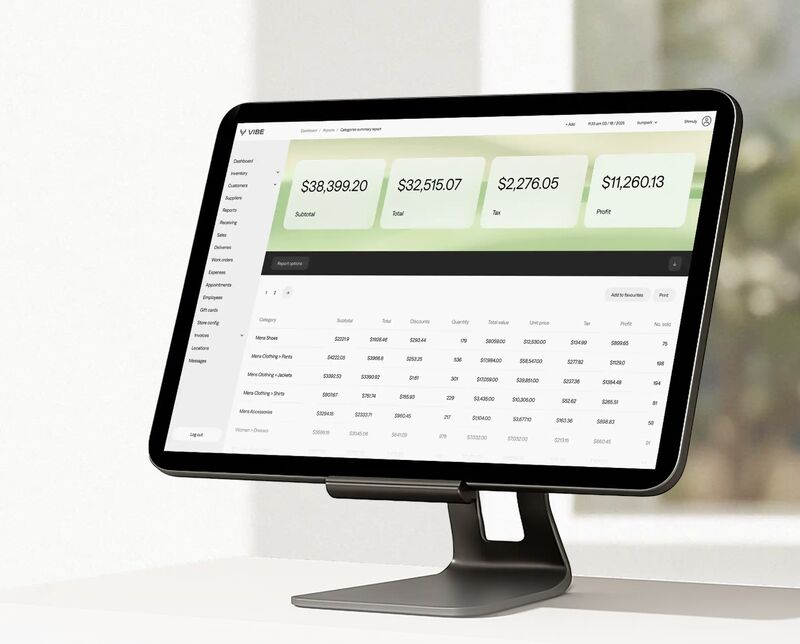
A POS system in a retail store is one of the most important instruments for gathering and analysing data, which is one of the most significant resources available to modern retailers today. Every transaction that is entered into the system adds to the expanding corpus of business intelligence that can be used to guide decisions about everything from staffing schedules to product ranges.
Sales statistics produced by a point-of-sale system, for instance, can show which employees accomplish the highest transaction values, which products perform best at different periods of the year, and which hours of the day see the most foot traffic. Equipped with this knowledge, a manager of a retail store can make judgements based on facts rather than just gut feeling.
Gaining insight into consumer purchase patterns is especially effective. Individual customer purchase histories can be tracked using a POS system in a retail store that is coupled with a loyalty program, allowing for customised promotions and focused advertising campaigns. Large companies with specialised analytics teams used to be the only ones with this kind of customer intelligence, but modern point-of-sale technology has made it available to shops of all sizes.
Employee Supervision and Responsibility
The performance of employees and upholding accountability are both crucial functions of a POS system in a retail store. Every transaction is linked to a single employee because the majority of contemporary systems enable individual employees to log in using distinct credentials. In addition to discouraging dishonest behaviour, this facilitates the identification of training needs, the rewarding of top performers, and the eventual resolution of any differences.
Managers can examine whether employees handle refunds the most, process the most transactions, or apply manual discounts unusually frequently. Without the reporting features of a POS system in a retail store, this level of visibility would not be feasible, and it significantly supports an environment of accountability and ongoing development.
Loyalty and Customer Experience
A dependable point-of-sale system supports the trust, convenience, and consistency that form the foundation of a retail store’s connection with its patrons. Customers are much more likely to come back when they are assured of prompt service, accurate recording of their loyalty points, and hassle-free returns or exchanges.
Staff members may swiftly check client purchase histories, handle refunds with no difficulty, and accurately apply promotional pricing thanks to a POS system in a retail store. A professional and reliable shopping experience is the result of these seemingly insignificant optimisations. This consistency is crucial at a time when word-of-mouth recommendations and consumer reviews can make or break a retail firm.
The Argument for Investment Based on Finance
Due to the projected upfront expenses, several retailers—especially smaller independents—are hesitant to invest in a point-of-sale system. The return on investment, however, becomes evident when the entire financial picture is taken into account. A stronger bottom line is the result of fewer pricing errors, better purchasing choices, decreased stock discrepancies, increased client retention, and enhanced staff efficiency. When installed and utilised correctly, a POS system in a retail store can pay for itself numerous times over.
Additionally, POS technology is now much more accessible and reasonably priced thanks to cloud-based platforms. Even the tiniest retail location can now get enterprise-level capability without incurring prohibitive capital expenditures thanks to subscription-based pricing structures.
In conclusion
The retail industry is changing quickly, and companies who embrace the technologies that give them a competitive edge will be the ones that prosper. It is essential to have a POS system in a retail store. The advantages are extensive and wide-ranging, ranging from precise, effective transactions to strong stock management, from actionable company intelligence to increased customer loyalty. The dilemma for any manager or owner of a retail establishment who has not yet made the decision is not whether to purchase a point-of-sale system, but rather when they will be able to afford not to.